
Why We Built Findex: The Portfolio Tracking Problem We Had to Solve
Findex was built to solve a problem its founders lived. Here is the story behind the platform, the decisions that shaped it, and why the investor-first model changes everything.
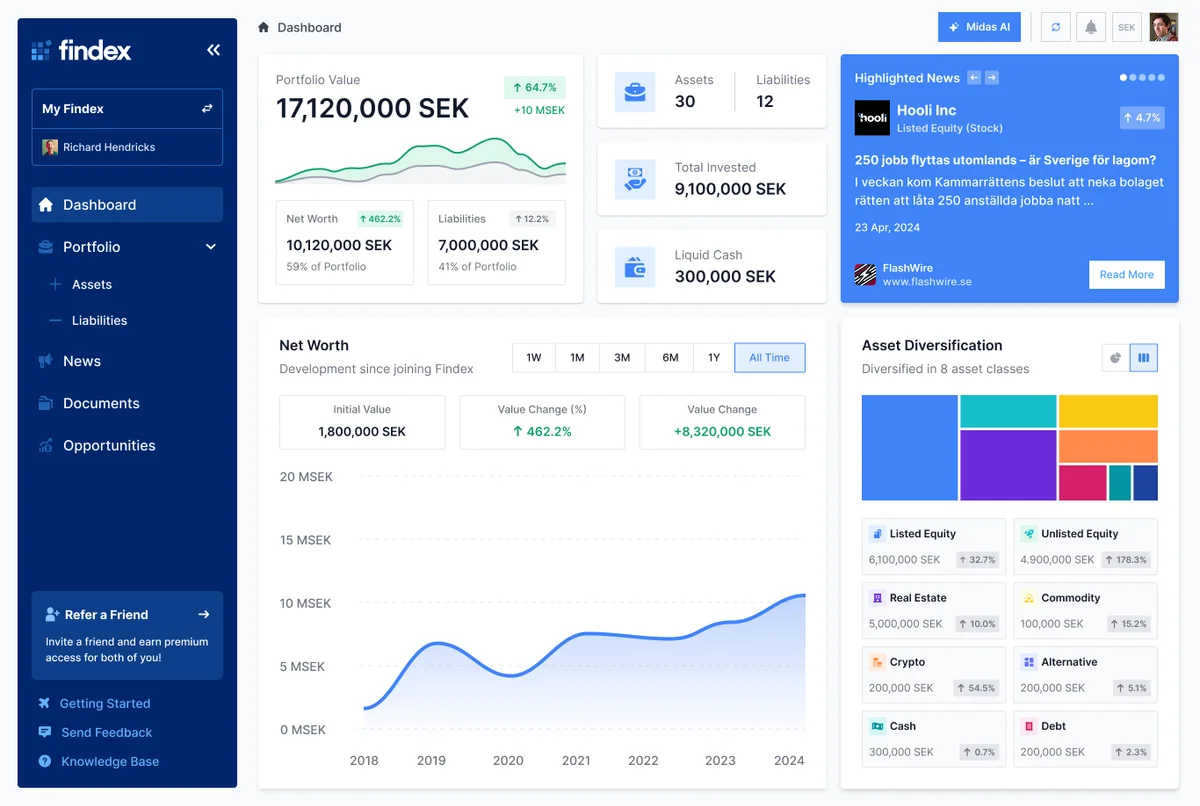
Findex was built because the problem was personal. The founders were managing their own investments across four banks, two brokers, and a spreadsheet that was perpetually out of date. No single view existed. No tool covered both listed equities and private holdings in the same place. The spreadsheet was not a solution. It was a symptom.
This is the story of the decisions that turned a personal frustration into a platform, and why each of those decisions points in the same direction: the investor comes first.
The Spreadsheet Everyone Uses but Nobody Admits To
Ask most investors how they track their portfolio. The honest answer, for the vast majority, is some version of a spreadsheet, possibly alongside three or four different banking apps, each showing one piece of the picture.
This is not a personal failing. It is a structural problem. Banks are built to show you what you hold at that bank. No more. If you hold an ISK at Avanza, a depot at Nordnet, a pension at Folksam, and a stake in a private company, no institutional tool is designed to show all of it together. The bank's interest is in showing you what is theirs, not everything that is yours.
The result is the "audit mentality", where managing your portfolio actually means reconciling four different data sources and hoping the spreadsheet is roughly accurate. This is not portfolio management. It is manual data entry dressed as oversight.
The question that started Findex was simple: *"What is my actual net worth right now?"*
Not an estimate. Not a number that is accurate if you squint at the spreadsheet. The real number: all assets, all liabilities, all currencies, updated continuously.
No good answer existed for Nordic investors. So the founders built one.
The First Solution Was Too Small
The initial idea was focused: a portfolio tracker designed for Nordic investors, covering the banks and brokers that existing tools ignored. The Nordic market was underserved. Finsquid was building the bank connection infrastructure that made it technically possible. The timing was right.
Early alpha users (primarily angel investors and HNW individuals) used the product and confirmed the problem was real. But they also kept asking for things that were not in the plan.
They wanted to track private holdings, not just listed equities. They wanted to see their real estate alongside their stocks. They wanted to understand their total net worth, including liabilities. And increasingly, they asked a different kind of question: not just "what do I have?" but "where should I go to manage it better, and who can I actually trust?"
The pattern was consistent enough to be clarifying. The problem was not the tracking tool. It was the system around the investor: fragmented, institution-biased, and structurally misaligned with their interests.
The pivot was not a product decision. It was a recognition that solving the problem properly required building something bigger than a tracker.
Three Decisions That Defined What Findex Would Become
The platform that emerged from this period was shaped by three explicit choices. Each one had a cleaner alternative. Each one was deliberately rejected.
No own products
The simplest path to revenue in fintech is to distribute financial products: funds, insurance, lending. The distribution model generates fees. The products are ready-made. The GTM is obvious.
Findex chose not to do this. The reason is structural: a platform that holds a product shelf cannot give neutral advice about whether that shelf's products are the right choice. The conflict of interest is not a risk. It is a certainty, because the platform's revenue depends on product uptake, not investor outcomes.
The decision to hold no own products was a decision to make the business model harder in the short term, in exchange for something more durable: genuine alignment with the investor.
Investor-first, not institution-first
Every existing tool in this space was built from the institution's perspective. Banks show their products. Portfolio trackers integrate with the institutions they have commercial relationships with. Even well-funded European competitors build for markets where their data partnerships are strongest.
Findex was built around the investor. The question is not "what can we show from our partners?". It is "what do you actually hold, and how do we show it accurately?".
If an asset is hard to integrate, the answer is to add manual entry. If a bank is not in the automatic feed, the answer is to build the integration. Your complete picture is the goal. Everything else is a means to it.
Aggregator, not intermediary
The third decision was structural: Findex would be a platform, not a party. An aggregator, not an advisor. A marketplace, not a product distributor.
This matters because of what it protects. An aggregator has no stake in which partner an investor chooses, which product they select, or whether they take action at all. The incentive is to show the complete picture accurately and to connect the investor with partners who can add value. The revenue comes from those partnerships succeeding, not from pushing any particular outcome.
Why Track, Optimize, Grow Is Not a Marketing Line
The three-part framework (Track, Optimize, Grow) describes how Findex actually works. It is not a marketing category structure. It is a logical sequence that reflects how investors move from chaos to control.
Track is the foundation. Without a complete, accurate picture, every subsequent decision is made on partial information. The 50+ Nordic bank and broker connections, the manual asset entry, the multi-currency support, all of it exists to solve one problem: getting the real number.
Optimize is what becomes possible when Track works. Concentration risk becomes visible. Fee drag becomes quantifiable. Tax-inefficient structures become identifiable. You cannot act on what you cannot see, and once the full picture is available, the places where money is being lost quietly become apparent.
Grow is access to relevant opportunities, structured around your actual portfolio. Not product pitches from a distribution network. Deals, funds, and partner services that connect to what you already hold, what you are missing, and what fits your risk profile.
Each stage builds on the previous. Track without Optimize is just data. Optimize without a complete picture is guesswork. Grow without the full portfolio as context is distribution dressed as advice.
What Findex Deliberately Is Not
The decisions about what not to build are as important as what was built.
Not a bank. A banking license in the Nordics requires significant capital reserves, compliance infrastructure, and regulatory commitment that would make the platform slower, heavier, and structurally conflicted. Banks have balance sheets and products tied to them. Findex has neither. It never moves money. It never holds assets. It is read-only by design.
Not an advisory service. In-house advisory is expensive to deliver at quality, requires regulatory authorisation in each market, and creates the exact conflict the platform was built to avoid. The model at Findex is to provide the picture and connect the investor with the right external advisor, not to become the advisor.
Not another niche app. Crypto-only trackers, crowdfunding platforms, and ISK-focused tools each solve one slice of your portfolio. The problem is not the slice. It is that slices add fragmentation. If you hold crypto, equities, real estate, and private positions, you do not need five apps. You need one picture.
Where Findex Is Now
The numbers, as of early 2026: over 2 billion SEK tracked on the platform. 15 companies using the IR Portal. Approximately 100 active users with a pipeline growing through the IR flywheel: when a company invites a shareholder via the IR Portal, that shareholder gets a MyFindex portfolio view pre-populated with their holding.
The flywheel is the structural moat. The IR Portal solves a real B2B problem: cap table management, investor communications, document sharing. And every IR client brings their shareholders into the ecosystem, each of whom has a portfolio that benefits from what MyFindex provides. The two products reinforce each other at scale.
The vision is unchanged from the original question: a digital family office for anyone with a portfolio, regardless of size. The tools, the oversight, and the deal access that were previously reserved for the wealthiest investors, available to anyone who is serious about managing what they have built.
The One Thing That Does Not Change
Every product decision at Findex starts from the same question: does this serve the investor, or does it serve the platform?
These can align. When the platform earns by connecting investors with partners who deliver genuine value, both win. When they do not align (when a feature would generate revenue but compromise the independence or accuracy that the investor depends on) the answer is no.
That principle is not new. It is what the spreadsheet problem demanded from the beginning. The investor could not trust the existing tools to give them a complete, unbiased picture. Findex was built to be the answer to that specific mistrust.
Frequently Asked Questions
What is Findex? Findex is a two-sided wealth management platform connecting individual investors and companies with shareholders. For investors, MyFindex provides a consolidated view of all assets and liabilities, portfolio analysis, and access to investment opportunities. For companies, the IR Portal provides cap table management, investor communications, and document sharing. Shareholders invited via the IR Portal automatically receive a MyFindex portfolio view of their holding.
How is Findex different from a bank or wealth manager? Findex does not hold assets, move money, or distribute financial products. It is a read-only aggregator: it mirrors what investors hold across all institutions without custody or transaction capability. Unlike a bank or wealth manager, Findex holds no product shelf, receives no distribution fees, and has no incentive to recommend any particular product over another.
What assets can I track on Findex? Findex tracks all major asset classes: listed equities, unlisted equity, real estate, crypto, bonds, cash, commodities, collectibles, and alternatives. Liabilities including mortgages and loans are also tracked. Assets connected to banks and brokers update automatically via Findex integrations; private and non-tradeable assets can be added manually.
Is Findex available outside Sweden? Findex is Nordic-first, with primary bank and broker coverage for Sweden, Norway, Denmark, and Finland. The platform is available in Swedish and English. European expansion is planned as open banking regulation (PSD3/FIDA) standardises data access across markets.
Who is Findex built for? Findex is built for investors whose financial life has grown beyond what any single institution can manage: multi-asset, multi-institution portfolios that need a single coherent view. The primary user is the Nordic individual investor (entrepreneur, angel investor, or wealth-building professional) with assets across multiple institutions and asset classes. The IR Portal is built for post-seed Nordic companies managing shareholder relationships.
*Without a unified view, you are not managing your portfolio. You are auditing it. Findex gives you a real-time picture across every asset class you hold. Get started free.*
Keep reading
Related guides
The Best Kubera Alternatives in 2026
Private Banking for Everyone: The Tools the Wealthiest Investors Use — and Who Has Access to Them
How to Manage Investments Across Multiple Banks & Brokers: A Modern Guide to Unified Portfolio Oversight
Managing investments across multiple brokers introduces inefficiency and risk. Discover how to achieve data consolidation, automate reporting, and optimize performance with Findex.
Your complete net worth, finally in one place.
Join investors using Findex to consolidate, track, and grow their portfolios. One view of everything you own.
No payment information required.