
How to Track Your Full Investment Portfolio | Findex
Most investors have no single view of what they own. Here is how to build one — covering every asset type, institution, and currency.
You probably do not know your actual net worth right now. Not because the information does not exist — it does, across four or five institutions. But no single place shows it.
This is the core problem with how most investors track their portfolios. The data is there. The overview is not.
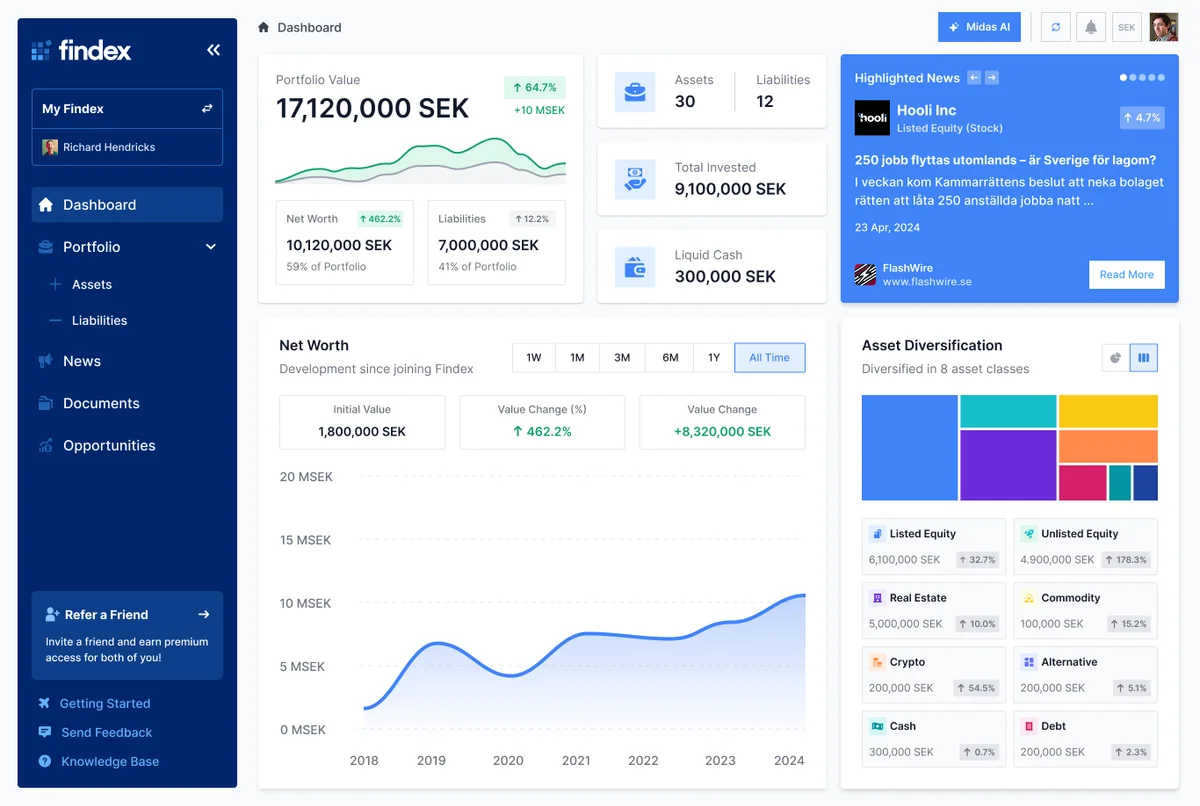
Portfolio tracking is the practice of monitoring the performance, allocation, and current value of all investments across accounts and asset classes in one unified view. Done well, it replaces the audit mentality — reconciling statements from multiple sources — with actual oversight: seeing the full picture, continuously, without manual effort.
This article covers how to build that picture, what it needs to include, and where most investors leave gaps.
The Hidden Cost of Fragmented Tracking
Most investors underestimate what fragmented tracking actually costs them. The cost is not just time, though that is real. It is the decisions made on partial information.
Cognitive overhead. Maintaining a mental model of a portfolio spread across four institutions, three currencies, and two asset classes requires constant manual reconciliation. Most investors carry a rough approximation in their heads — not the accurate number, but a best guess. Best guesses lead to best-guess decisions.
Behavioural risk. An investor who cannot see their full allocation cannot accurately assess concentration risk. If 40% of the portfolio is in a single stock across multiple accounts, but each account is viewed separately, the concentration is invisible. Decisions that would be clearly wrong with the full picture look acceptable in fragments.
Fee drag and structural inefficiencies. Costs embedded in portfolio construction — fund fees, account maintenance charges, tax-inefficient account structures — only become visible when the full picture is assembled. An investor reviewing one account at a time will not notice that they are paying 1.5% in fund fees on three different platforms for essentially the same exposure.
The cost of not having a complete view is not theoretical. It is a real, ongoing financial drag that most investors accept because they have no tool to address it.
What Good Tracking Actually Requires
A portfolio tracker that genuinely solves the problem has three properties. The absence of any one of them leaves meaningful gaps.
1. Everything in one place — not "most things"
The test is not whether the easy assets are tracked. It is whether the hard ones are. Listed equities and cash are straightforward — every bank app shows these. The complete picture requires:
- Unlisted equity (startup investments, private company shares)
- Real estate (primary residence as an asset, investment properties)
- Alternative assets (crypto, commodities, collectibles, art)
- Liabilities (mortgages, loans, credit lines)
- Foreign holdings
A tracker that covers listed equities and bank balances is not a portfolio tracker. It is a partial view that creates the illusion of a complete one.
2. Consistent categories across all asset types
Different institutions describe the same things differently. A fund at Avanza and the same fund at Nordnet will appear under different labels. Real estate has no standard market value format. Crypto is denominated in multiple currencies with different reporting conventions.
Good tracking requires a consistent taxonomy applied across all assets — the same categories, the same currency base, the same valuation methodology — so that comparisons across positions are meaningful. Without this, the aggregated view is arithmetically correct but analytically useless.
3. Time series data — not just today's snapshot
Knowing what the portfolio is worth today matters. Knowing whether it has grown or declined relative to contributions, and how the allocation has shifted over time, matters more.
A tracker without historical data can tell you where you are. It cannot tell you how you got there, whether the trajectory is what you intended, or how specific allocation decisions have performed. Time series data is what converts a snapshot tool into a management tool.
The Three Types of Assets and How Each Enters the System
Not all assets can be tracked the same way. Understanding the three data levels helps set expectations for how much of the portfolio updates automatically and what requires manual maintenance.
- Type: Provider (automatic) — How it works: Connected via integrations to banks and brokers; updates continuously — Examples: Banks, ISK accounts, pension providers, brokers — 50+ Nordic providers via Findex integrations
- Type: Ticker (semi-automatic) — How it works: Market data updates automatically; user adds transaction records — Examples: Listed stocks, funds, ETFs, publicly traded bonds, listed crypto
- Type: Manual — How it works: User enters and updates value; no automatic market data feed — Examples: Real estate, unlisted equity, art, collectibles, unlisted debt, private loans
A complete portfolio view typically includes all three types. The automatic connections handle most of the volume. The manual entries handle the assets that tend to be the largest and most complex.
Building Your Master View: What Should Be Included
A complete portfolio master view includes the following categories. Use this as a checklist.
Assets:
- Listed equities (all ISK, depot, and pension accounts across all institutions)
- Unlisted equity (private company shares, startup investments, employee equity)
- Real estate (all properties at current estimated market value)
- Crypto and digital assets
- Bonds and fixed income
- Cash (all current accounts, savings accounts, cash holdings)
- Alternative assets (commodities, art, collectibles, other)
Liabilities:
- Mortgages (outstanding balance, interest rate, institution)
- Personal loans
- Credit lines and revolving credit
- Any other financial obligations
The net worth calculation: Total assets minus total liabilities. This is the number that matters. It should be accurate, current, and visible at all times — not estimated quarterly.
Before and After: A Real Portfolio Case
Consider an investor with the following holdings:
- ISK at Avanza (equities, funds)
- Depot at Nordnet (equities, ETFs)
- Savings account at SEB
- Pension fund at Folksam
- Bitcoin and Ethereum on Coinbase
- A rental property in Stockholm
- Startup equity from a seed investment two years ago
- A mortgage on the rental property
Before a consolidated tracker: six separate logins, a spreadsheet with columns for each account, monthly manual updates, a net worth figure that is accurate to within a margin of error of 5–15%, and no visibility into how the full portfolio is allocated across asset classes.
After: one view. All seven accounts connected automatically or added manually. Net worth calculated in real time. The allocation breakdown shows that the rental property represents 45% of total net worth, creating a concentration in real estate that was not obvious when viewed account by account. The Coinbase positions represent a further 12%, making physical assets 57% of a portfolio that the investor thought of as primarily equity-focused.
That is the information needed to make allocation decisions intentionally. The spreadsheet could not surface it.
What Portfolio Tracking Does Not Do
It is worth being precise about the limits of tracking to set accurate expectations.
Portfolio tracking is not financial advice. It is not portfolio management. It does not tell you what to buy, sell, or rebalance. It does not tell you whether your allocation is appropriate for your risk tolerance.
What it does: it gives you the complete, accurate picture on which every subsequent decision — whether made by you, an advisor, or an AI — can be based. The decisions themselves require judgement. The picture is the input to that judgement.
A useful way to think about it: you cannot manage what you cannot see. Tracking provides the visibility. Everything else follows from that.
Frequently Asked Questions
What is portfolio tracking? Portfolio tracking is the practice of monitoring the current value, performance, and allocation of all investments across accounts and asset classes in a single unified view. It provides an accurate picture of total net worth by aggregating assets and liabilities from all institutions and sources.
How do I track all my investments in one place? Connect bank and broker accounts through a platform that supports automatic data integration for your institutions. Add assets that cannot be connected automatically — real estate, unlisted equity, crypto held in self-custody — as manual entries. The result is a single view updated continuously as market prices and account balances change.
What is a net worth tracker? A net worth tracker is a tool that calculates total net worth by aggregating all assets and subtracting all liabilities. Unlike a portfolio tracker that focuses on investment positions, a net worth tracker includes all forms of value (including real estate and personal assets) and all financial obligations (including mortgages and loans).
Can I track private equity or unlisted shares? Yes. Unlisted equity — shares in private companies, startup investments, employee equity — can be added manually with a user-defined valuation. The value does not update automatically (there is no market price), but the position is included in the portfolio view and net worth calculation.
How often does Findex update portfolio data? Assets connected via Findex integrations (banks and brokers) update when you open the app or manually refresh. Listed securities update with market data on an ongoing basis. Manual assets update when you choose to revise the valuation.
Is it safe to connect my bank accounts? Findex uses read-only, non-custodial connections to bank and broker accounts. This means Findex can view account data but cannot initiate transactions, move money, or access your credentials beyond the initial authentication. Data is encrypted in transit and at rest and is not sold to third parties.
*Without a unified view, you are not managing a portfolio — you are auditing it. Connect your accounts and see the full picture.*
Your complete net worth, finally in one place.
Join investors using Findex to consolidate, track, and grow their portfolios. One view of everything you own.
No payment information required.