
Democratizing Private Banking: Tools the Wealthiest Use, Open to All
Family offices give wealthy investors consolidated oversight, deal access, and independent advice. Findex makes these three functions available to every investor, regardless of portfolio size.
If you hold a 3M SEK portfolio, your bank will never give you the three things a family office gives its clients: a consolidated view of everything you own, structured access to deals that never reach the public, and an advisor whose only mandate is your outcome. Findex was built to change that access equation.
This is not about making finance cheaper. It is about dismantling a structural inequality that has existed in wealth management for decades, where the quality of financial oversight available to you depends entirely on how much you already have.
What a Family Office Actually Provides
A family office is a private wealth management firm that serves a single ultra-high-net-worth family or a small group of HNW clients. The term is often used loosely, but in practice a family office delivers three core functions that most investors never access.
Consolidated oversight. Every asset class, every institution, every currency, aggregated into a single picture. Not the picture one bank has of its own accounts, but the complete view: listed equities, private holdings, real estate, cash, bonds, and alternatives. This is maintained continuously, not in an annual review meeting.
Curated deal access. Private market opportunities (co-investments, direct deals, exclusive funds) are distributed through trusted networks. Family offices sit inside those networks. The average investor, even with a substantial portfolio, is outside them.
Independent advisory. The family office advisor's mandate is explicitly the client's outcome. There is no product shelf, no internal fund to distribute, no commission structure that creates a conflict of interest. The advisor's success is measured against the client's portfolio performance, not against distribution targets.
These three functions are expensive to deliver manually. Historically, that meant only families with 50M SEK or more in investable assets could justify the cost.
Everyone below that threshold was pushed back to a bank, which sells you the first product on its own shelf, not the best option from a neutral comparison.
The Gap in the Market: Who Falls Through
Sweden has approximately 4–4.5 million individuals holding ISK accounts. A significant proportion of them have diversified portfolios across multiple institutions. They hold listed equities at Avanza, bonds and savings at SEB or Handelsbanken, crypto on Coinbase, a rental property or two, and possibly an ownership stake in a startup or a private company.
If you sit in this segment, you are not the mass market. You are financially active, informed, and often managing more complexity than the average bank customer. But you fall below the threshold where traditional private banking becomes available.
What you currently use to manage your portfolio: multiple banking apps that each show one institution, a spreadsheet that is perpetually out of date, and occasional statements that arrive on their own schedule.
What you are missing:
- A single accurate net worth figure, updated continuously
- The ability to see concentration risk across all positions, not just within one institution
- Access to investment opportunities that match your actual portfolio profile
- An advisor who can see the full picture before making a recommendation
If you sit in the 2 to 5M SEK range, you are too large to be served well by a standard bank app, and too small to justify the cost of a traditional private banking relationship. This is the gap Findex was built for.
Three Family Office Functions, Productised
The insight behind Findex is straightforward: the three functions that make a family office valuable can be productised. Technology can deliver the same oversight, the same access, and the same independence, at a fraction of the cost, to anyone with a portfolio worth tracking.
The Consolidated View
What a family office does manually: a team aggregates all accounts, positions, asset classes, and currencies into a single master view. This is updated continuously, not quarterly.
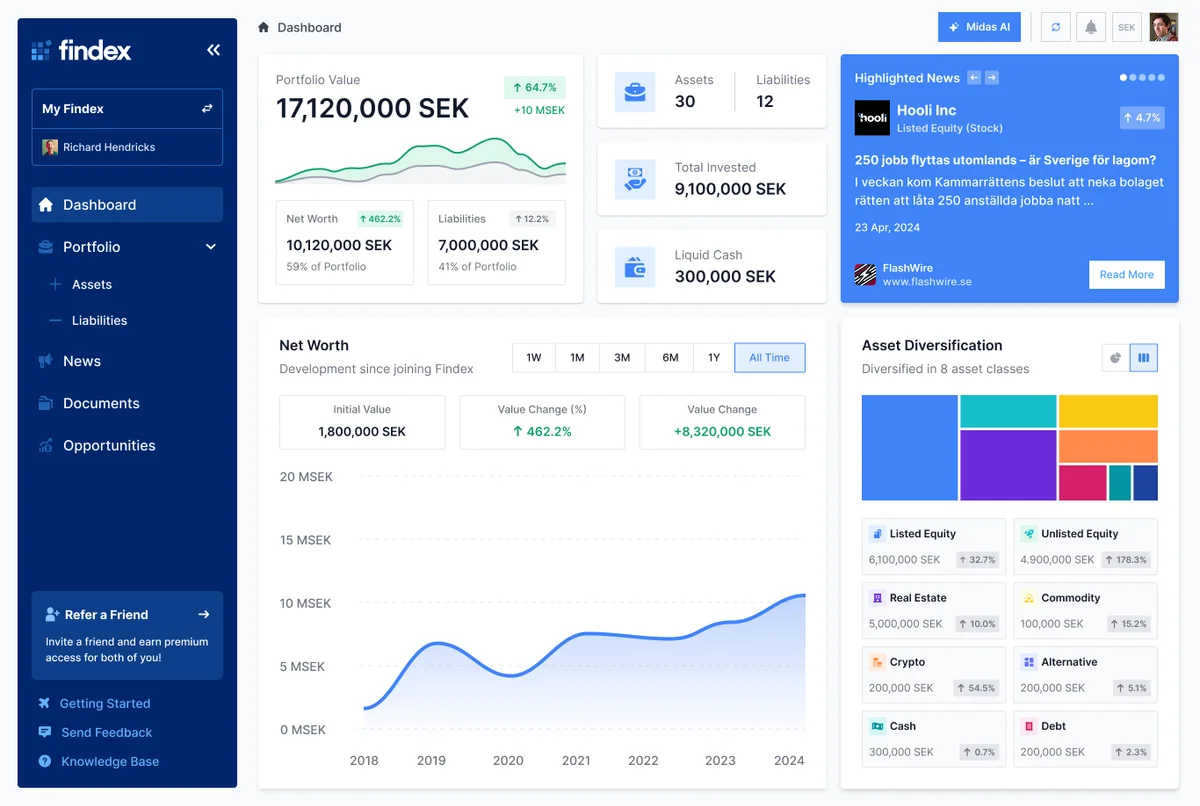
What Findex does: connects 50+ Nordic banks and brokers automatically via Findex integrations, allowing users to see their full portfolio (stocks, funds, real estate, crypto, unlisted equity, and cash) in one place. Assets that cannot be connected automatically (private equity, art, collectibles) can be added manually. The result is a single net worth figure, updated in real time, that reflects the entire financial picture.
The difference from a bank app: a bank app shows what is held at that bank. Findex shows everything, regardless of which institution holds it.
Deal Access
What a family office does: maintains relationships with investment banks, fund managers, and deal originators. Curates deal flow from these sources and evaluates fit against the client's portfolio, risk profile, and goals. The client sees deals that are relevant to them, not every deal the network produces.
What Findex does: the Opportunities marketplace surfaces investment opportunities, debt products, insurance, and wealth management services from qualified partner firms. Access is not gated behind a minimum asset threshold. The matching is against the investor's actual portfolio, not a generic demographic category.
The key difference: Findex holds no product shelf. There is no internal fund to push, no commission structure that makes one recommendation more profitable than another. Partners pay a success fee when a match results in a transaction. The incentive is alignment, not volume.
Independent Oversight
What a family office does: reports across all positions regularly, identifies concentration risk, flags cost inefficiencies, and surfaces tax-structural problems. The advisor is looking for problems the client did not know to ask about.
What Findex does: Midas AI provides portfolio analysis that identifies patterns across the complete picture: fee drag, concentration risk, diversification gaps, and performance attribution. This is not a one-time analysis triggered by a meeting request. It is continuous, operating on live portfolio data.
The difference from a bank's advisory service: a bank advisor can only see what is held at their institution. The analysis is necessarily partial. Midas AI operates on the full picture.
What "Democratising" Actually Requires
The word "democratising" is used freely in fintech. It usually means making something cheaper, or making an app accessible on a smartphone. That is not the same thing.
Genuine democratisation of private banking requires three things that most platforms do not provide:
Removing the institutional conflict. A bank cannot give independent advice while it has a product shelf. A platform built around distributing one company's products cannot be neutral. The independence has to be structural (written into the business model), not just claimed in marketing copy.
Nordic bank coverage. Most European portfolio tracking tools were built for the UK, US, or German markets. They connect to the major banks in those markets and leave Nordic investors with a partial picture. Findex was built Nordic-first, with coverage of the Swedish, Norwegian, Danish, and Finnish institutions that Nordic investors actually use.
Multi-asset support. The average Nordic investor with a substantial portfolio holds more than listed equities. Real estate is a significant asset class for most households. Private equity, startup investments, crypto, and alternative assets are increasingly common. A platform that only tracks listed securities is tracking a partial portfolio, regardless of how well it tracks those securities.
Each of these requirements eliminates a significant portion of the platforms that claim to offer private-banking-quality portfolio management. The combination of all three is what makes the full picture possible.
Who This Is Built For
Findex is not built for a demographic. It is built for a situation: the point at which a person's financial life has grown beyond what any single institution can manage.
The entrepreneur with multiple income streams. An ISK at Avanza, a depot at Nordnet, a pension fund, startup equity from a company they founded, a property they rent out, and crypto from 2020 that is now worth something. None of these institutions can see the full picture. The entrepreneur cannot either, not without a system designed for this.
The angel investor. Five to fifteen early-stage positions, each at a different stage, each requiring some level of ongoing tracking. Plus a personal portfolio that predates the angel activity. The complexity is real, and the tools available to manage it are the same spreadsheets every other investor uses.
The wealth-building professional. Building towards financial independence through disciplined portfolio construction. The holdings are diversified across multiple asset classes by design, but the oversight tools are still limited to single-institution views.
The common thread: all three need a complete picture to make good decisions. All three currently operate without one. If you recognise yourself here, the gap is the same regardless of which profile fits.
Private Banking Quality Is Not a Threshold. It Is a Structure
The historical reason private banking quality was reserved for large portfolios was cost: it was expensive to deliver manually. Technology has removed that constraint.
What technology cannot remove is a conflict of interest. A platform built to distribute financial products will always have an incentive to push those products, regardless of whether they are the best option for a given investor. The quality of private banking was never just the tools. It was the alignment between the advisor's incentive and the client's outcome.
Findex's position is that these should not be separated. The platform earns when partners succeed with investors, not when investors are pushed towards products that fit the partner's distribution target. The oversight function is only valuable if it operates on a complete picture, without the distortion of institutional bias.
That is what it means to democratise private banking. Not a cheaper version of the same product. A structurally different one.
What Investors Can Do Now
The foundation of private-banking-quality oversight is the same for every portfolio size: everything in one place. The oversight, the analysis, and the access all depend on the picture being complete.
Most investors reading this do not have that picture. They have four or five partial views, a spreadsheet, and a rough estimate. The gap between that and a real-time, accurate view of total net worth is the first thing to close.
Start there. Connect the accounts that can be connected automatically. Add the assets that need to be added manually. Get the complete picture first, because the optimization and the access only make sense when you can see everything.
Frequently Asked Questions
What is private banking? Private banking is a category of wealth management services offered by banks and financial institutions to clients with significant assets, typically above 10–15 million SEK. Services typically include personalised investment advice, portfolio management, tax planning, and estate planning, delivered by a dedicated relationship manager.
What is a family office? A family office is a private wealth management firm serving one ultra-high-net-worth family or a small number of HNW clients. Unlike a bank or wealth management firm, a family office works exclusively for its clients and holds no financial products to sell. Services include investment management, consolidated reporting, deal access, and tax and estate planning.
Who is private banking traditionally for? Traditional private banking in Sweden and the Nordics is typically available to clients with at least 5–15 million SEK in investable assets, depending on the institution. Family office services are generally reserved for clients with 50 million SEK or more.
What is the difference between private banking and wealth management? Wealth management is a broader category that includes investment advice, portfolio management, and financial planning for a range of client types. Private banking is a subset that typically includes additional services (lending, estate planning, access to exclusive investment opportunities) delivered by a dedicated relationship manager to high-net-worth clients.
How does Findex democratize private banking? Findex productises the three core functions of private banking oversight: consolidated portfolio tracking, access to investment opportunities through a neutral marketplace, and AI-powered portfolio analysis. These functions are available to any investor regardless of portfolio size, without minimum asset thresholds, and without the institutional conflicts of interest that characterise traditional bank advisory.
What asset types can I track on Findex? Findex supports all major asset classes: listed equities (stocks, funds, ETFs), unlisted equity (private company shares), real estate, crypto, bonds, cash, commodities, collectibles, and alternative assets. Liabilities including mortgages and loans are also tracked, enabling accurate net worth calculation.
*Without a unified view, you are not managing your portfolio. You are auditing it. Findex gives you the oversight, analysis, and deal access that private banking has historically reserved for the wealthiest. Get started free.*
Keep reading
Related guides
From Excel Chaos to Digital Private Banking: Why We Built Findex
The Best Kubera Alternatives in 2026

How to Manage Investments Across Multiple Banks & Brokers: A Modern Guide to Unified Portfolio Oversight
Managing investments across multiple brokers introduces inefficiency and risk. Discover how to achieve data consolidation, automate reporting, and optimize performance with Findex.
Your complete net worth, finally in one place.
Join investors using Findex to consolidate, track, and grow their portfolios. One view of everything you own.
No payment information required.