
What Are the Risks of Private Market Investments? A Guide for Modern Investors
Private market investing offers unique opportunities but requires disciplined oversight. Learn to manage illiquidity, valuation lag, and reporting complexity with the right tools.

Discussions surrounding private market investments tend to emphasize return potential, diversification benefits, and access to high-growth companies. However, the unique risks that arise after capital is allocated often receive insufficient attention. For investors seeking to make private assets a lasting part of their portfolio, a thorough understanding of these risks is not merely suggested—it is critical for robust decision-making and long-term oversight.
These are not deterrents to private markets. Rather, they are defining characteristics of the asset class—features that require disciplined management, structured processes, and reliable information architecture.
1. Illiquidity: The Core Structural Constraint
Illiquidity is the primary feature distinguishing private investments. Once committed, capital is generally inaccessible for extended periods—often 5 to 12 years—until a liquidity event occurs, such as an IPO, acquisition, or fund maturity.
How Illiquidity Impacts Investors
- No on-demand exits: Private investments cannot be sold readily; there is no public market for immediate liquidity.
- Secondary markets are limited: Although certain private share marketplaces exist, they are often thinly traded, opaque, and transactions may require significant discounts.
- Reduced flexibility during market stress: In turbulent periods, investors cannot swiftly reallocate or liquidate these assets to respond to changing market conditions.
Key point: Illiquidity is a direct operational limitation for portfolio management, sharply constraining allocation responsiveness.
2. Valuation Lag and Pricing Uncertainty
Unlike public securities, private assets are not valued daily. Their assessments depend on periodic, model-based processes—typically quarterly or annually—resulting in a lag between reported and actual value.
The Risks This Creates
- Outdated valuations: Reporting frequency seldom matches changes in economic fundamentals, leading to delayed recognition of value shifts.
- The “denominator effect”: During public market downturns, static private valuations can lead to inflated allocation percentages.
- Distorted allocation metrics: Without timely updates, net worth and risk exposure calculations can become inaccurate, misleading portfolio decisions.
Key point: Without frequent, current valuations, risk exposure and asset mix assessments may be fundamentally misaligned with reality.
3. Limited Transparency and Inconsistent Reporting
Private investments typically lack standardized, consistent reporting protocols. Information flow is often sporadic, diversified in its format, and dispersed across multiple platforms.
How Transparency Risk Manifests
- Inconsistent updates: Reporting standards vary significantly across funds and managers.
- Disparate delivery formats: Data may be distributed via portals, emails, or spreadsheets, complicating consolidation.
- Manual reconciliation burden: Aggregating this data requires manual effort, introducing both inefficiency and the risk of error.
Key point: When oversight relies on delayed and manual reporting, the ability to detect and address portfolio risk is substantially weakened.
4. Concentration and Allocation Risk
Higher minimum investment thresholds and longer lockup periods often mean private portfolios are less diversified.
Where Concentration Risk Arises
- Sector overexposure: Similar mandates across multiple funds can produce unintended overlap in sectors such as fintech or healthcare.
- Uneven capital deployment: As capital calls are irregular, idle cash or outsized positions can accumulate without systematic oversight.
- Unnoticed allocation drift: Exponential growth in certain investments, compounded by valuation lag, may result in excessive concentration.
Key point: Without systematic, real-time monitoring, concentration risk can increase gradually—and often without immediate detection.
5. Governance and Oversight Challenges
Participating in private markets often entails diminished influence over investment operations and exit strategies.
Key Governance Limitations
- Limited control: Investors, especially Limited Partners, have little direct influence over management actions or liquidity events.
- Long feedback loops: Evaluating manager performance can require many years, slowing managerial accountability.
- Dependence on third-party data: Oversight relies on the data provided by fund managers, limiting the ability to conduct independent verification.
Key point: Structural risks related to governance and oversight can prevent timely intervention and reduce transparency throughout the investment lifecycle.
6. How These Risks Compound Across a Portfolio
Addressing each risk in isolation is insufficient; the combined effect of these factors can magnify their impact on portfolio outcomes.
Common Compounding Effects
- Illiquidity + Valuation Lag = Hidden Exposure: Inability to transact, coupled with lagging valuations, can create blind spots in understanding real exposure.
- Fragmented Reporting + Concentration = Unseen Risk: Without integrated data, overlapping allocations and sector exposures can develop unchecked.
- Limited Governance + Long Horizons = Delayed Feedback: Extended reporting cycles and minimal control may delay identification and correction of underperformance.
Key point: At the portfolio level, compounded risks increase the importance of high-quality data, transparency, and active oversight.
7. Mitigating Private Market Risk: From Access to Infrastructure
Effective mitigation requires more than increased diversification. A robust data and oversight infrastructure is essential for institutional-grade risk management.
Practical Risk Mitigation Steps
- Establish a liquidity plan: Maintain sufficient liquid assets to meet capital calls, manage unforeseen needs, and preserve strategic flexibility.
- Track exposure dynamically: Employ real-time systems that comprehensively integrate public and private holdings to monitor risk across sectors, geographies, and liquidity profiles.
- Normalize data sources: Standardize performance, valuation, and allocation metrics (e.g., IRR, DPI, TVPI) for consistent portfolio analysis.
- Automate reporting: Reduce manual interventions and reporting lag to maintain data accuracy and support timely decisions.
- Stress test the portfolio: Continuously model potential impacts of market stress, capital calls, and liquidity constraints on portfolio structure.
Key point: Applying institutional-level data management and real-time oversight is critical for maintaining control over private allocations.
8. Technology’s Role: From Blind Spots to Real-Time Oversight
Legacy tools designed for public markets are insufficient for the oversight demands of private assets. Modern technology must integrate multi-source data and support complex portfolio management requirements.
How Findex Addresses Oversight Complexity
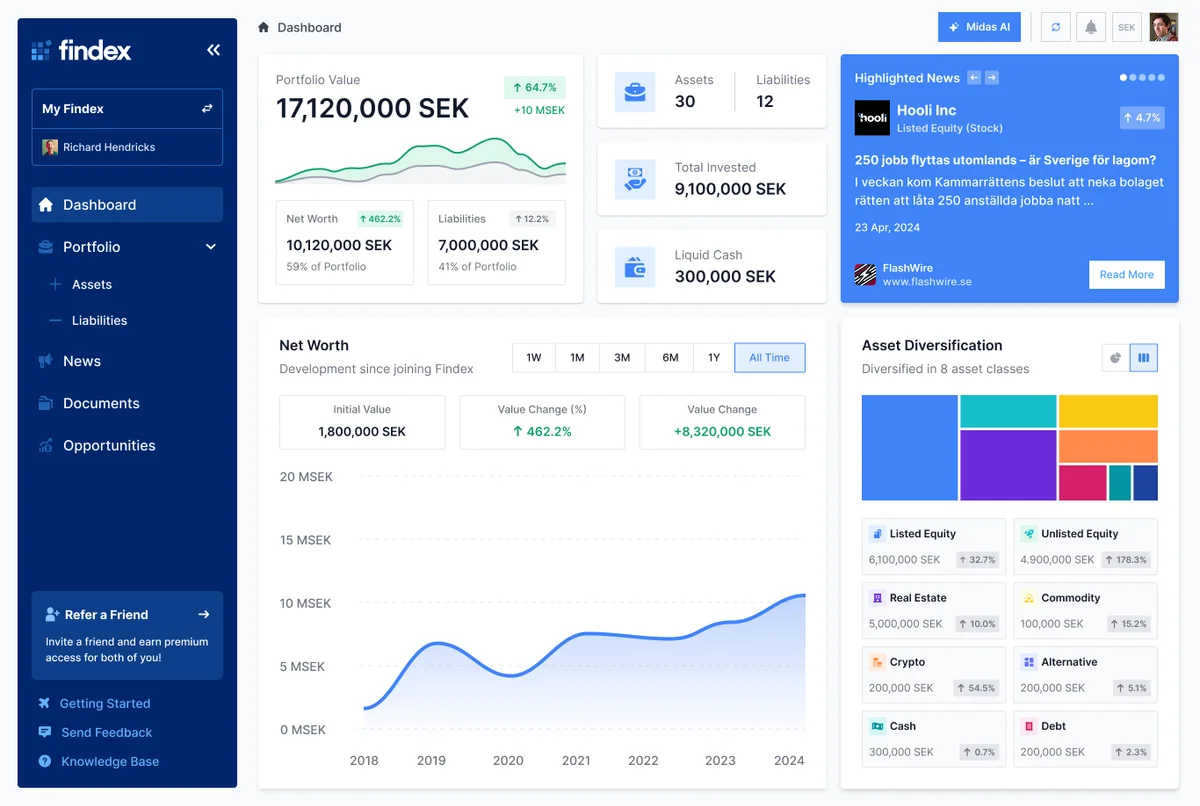
Findex provides the infrastructure necessary for a consolidated view of all holdings—public and private—delivering clarity and actionable insights:
- Aggregate holdings for a unified portfolio perspective.
- Normalize reporting across disparate systems, platforms, and administrator formats.
- Track real-time allocation, exposure, and liquidity metrics.
- Monitor investment performance consistently, using widely accepted standards (IRR, MOIC, DPI).
- Centralize documentation and reporting to streamline audits and compliance.
With Findex, investors move from fragmented, reactive oversight to proactive, data-driven portfolio management—enhancing risk control, transparency, and long-term performance.
👉 Explore how Findex elevates private market portfolio visibility.
Frequently Asked Questions (FAQs)
1. Are private market investments riskier than public ones?
Private market investments carry different, structurally rooted risks—particularly related to liquidity and governance—but do not inherently possess a higher risk of loss when properly managed.
2. How can I reduce illiquidity risk?
Strategies include vintage year diversification, careful liquidity planning, and matching capital commitments with personal income and upcoming obligations.
3. How do I know my true portfolio value if private valuations lag?
Use advanced platforms such as Findex to dynamically model and present current exposure, adjusting for valuation lag and associated effects.
4. What is the best way to track private and public assets together?
Implement a unified portfolio system that standardizes multi-asset data and delivers timely analytics and performance tracking.
5. What’s the single biggest operational risk in private investing?
Disjointed reporting—delayed or siloed data undermines visibility and impairs the effectiveness of portfolio oversight.
Keep reading
Related guides

How Private Markets Work: An Investor’s Guide to Understanding and Investing in Alternative Assets
Learn how private markets work—from private equity to real assets. Discover how they differ from public markets, what risks they carry, and how investors can access them today.

How Do I Access Private Market Investments as an Individual Investor?
Access to private markets is more available than ever, but management requires precision. Compare access strategies, understand persistent barriers, and learn to track and oversee private assets effectively.

How to Start Investing in Stocks with Confidence
Learn how to invest in stocks as a beginner with our comprehensive guide. We'll walk you through the practical steps and psychological considerations for investment success.
Your complete net worth, finally in one place.
Join investors using Findex to consolidate, track, and grow their portfolios. One view of everything you own.
No payment information required.