
How to Manage Investments Across Multiple Banks & Brokers: A Modern Guide to Unified Portfolio Oversight
Managing investments across multiple brokers introduces inefficiency and risk. Discover how to achieve data consolidation, automate reporting, and optimize performance with Findex.

Contemporary investors routinely diversify their accounts across a spectrum of providers:
- A legacy brokerage for public equities and ETFs
- A specialized platform dedicated to private credit
- A digital bank offering high-yield savings
- A crypto wallet for digital assets
This multi-platform strategy is both rational and advantageous in pursuing asset-class expertise and superior opportunities. However, institutional diversification inevitably introduces a structural issue: fragmentation. Without a cohesive oversight mechanism, it is challenging to maintain visibility into total exposure, true allocation, and real-time portfolio performance.
The consequence is clear: portfolios are often managed as collections of disparate accounts rather than as a single integrated system, resulting in opaque risks, diminished efficiency, and overlooked opportunities.
Why Investors End Up With Multiple Banks and Brokers
Holding assets with several institutions is seldom the result of a singular, planned decision. It's more accurately described as the logical progression of an investor’s financial activities and objectives.
- An initial paycheck typically establishes a retirement savings plan through an employer-sponsored scheme or pension account..
- A later desire for personal control prompts opening a self-directed brokerage.
- As wealth and knowledge grow, investors expand into real estate, private funds, or digital assets across various platforms.
This results in a “best-of-breed portfolio structure,” where each provider is selected for unique offerings—research capabilities, international access, or targeted yield optimization.
The Challenge of Best-of-Breed Diversification
While assembling a multi-provider portfolio can enhance product access, it segments data into institutional silos. Each institution provides insight into only a segment of overall wealth and exposure.
For today’s investor, the central challenge has shifted from finding investment opportunities to coordinating and managing total holdings across providers.
The Structural Challenges of Multi-Institutional Investing
Administering investments across multiple banks and brokers introduces fundamental operational inefficiencies. These constraints have direct ramifications for the precision and quality of portfolio management.
1. Inconsistent and Non-Standardized Data
Data from each platform is subject to different reporting conventions:
- Private investments might be valued based on the latest funding round at one provider, or an internal model at another.
- Performance measurements may be time-weighted at one institution and money-weighted elsewhere.
This lack of standardization undermines confidence in aggregation and makes cross-platform analysis imprecise without robust normalization procedures.
2. Delayed or Incomplete Insights
Disparate platforms hinder timely analysis of critical metrics, including:
- Aggregate sector exposures (e.g., the overall share of technology or energy holdings)
- Capital concentration in specific liquidity buckets
- Correlation dynamics between assets held at different institutions
As a result, detection of drift, concentration, or correlation risk is delayed—often until circumstances have already shifted materially.
3. Manual Reconciliation via Spreadsheets
Absent automation, investors resort to manual processes—exporting PDFs, CSVs, and statements for reconciliation. This approach is:
- Highly susceptible to input and formula errors
- Labor-intensive and time-consuming
- Not scalable for larger or more complex portfolios
Manual reconciliation serves as an audit of history rather than a real-time management solution.
How Fragmentation Hurts Performance and Allocation
The absence of unified oversight reduces precision in managing allocations and amplifies performance risk.
1. Allocation Drift
Investors may believe their allocations are static—for example, a fixed 60/40 stock-to-bond ratio. Yet, with asset growth in one account and additional purchases elsewhere, the actual allocation may deviate significantly without notice.
Unmonitored drift elevates risk exposure beyond intended levels and compromises expected return consistency.
2. Missed Opportunities
Liquidity scattered across multiple accounts obscures the investor’s ability to deploy capital efficiently. Without consolidated insight into total cash and equivalents, opportunities—such as tactical buying during market corrections or participating in limited co-investments—can be missed.
This leads to underperformance rooted not in subpar asset selection, but in a lack of operational integration.
What Effective Multi-Provider Portfolio Management Looks Like
Mastering wealth across institutions requires transitioning from account-level oversight to systems-level portfolio management.
The objective: establish a unified, continuously updated, and accurate ledger of all assets, liabilities, and exposures.
1. Centralized Data Aggregation
Sophisticated portfolio management requires an automated infrastructure that:
- Integrates with all financial institutions—banks, brokers, and alternative asset platforms
- Standardizes incoming data for performance and allocation tracking
- Synthesizes a comprehensive, real-time view of total net worth and asset distribution
This removes the need for manual data entry and ensures operational accuracy.
2. Cross-Asset Visibility and Risk Analysis
A robust management system should deliver:
- Comprehensive mapping of exposures across platforms (sector, geography, currency, rate sensitivity)
- Automated alerts for emerging concentration or liquidity risks
- Tools for scenario and stress testing linked to macroeconomic events
This elevates the investor from passive account monitoring to active, informed decision-making.
3. Automation and Accuracy
A centralized, automated platform fundamentally outperforms spreadsheet-based solutions—eliminating:
- Data transcription and calculation errors
- Version control disputes
- Inefficiencies in performance measurement and reporting
With automation, investors gain timely, actionable insights, resulting in consistently higher governance standards and better outcomes.
From Fragmentation to Financial Mastery with Findex
Managing wealth across institutions demands a rigorous, technology-driven approach. Findex provides investors with the infrastructure needed to consolidate, standardize, and automate the oversight of their entire asset base.
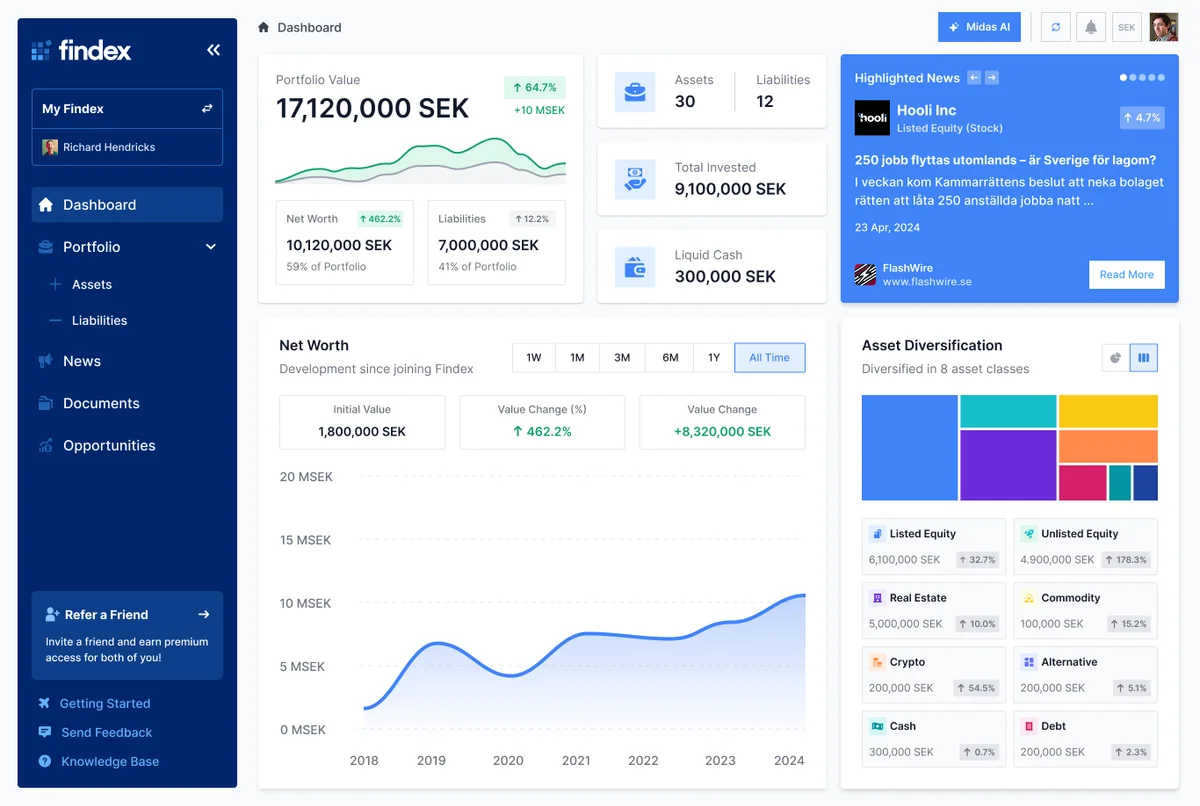
Findex: One Dashboard for Total Financial Oversight
- Seamlessly aggregates holdings across banking, brokerage, and private platforms
- Normalizes disparate data for unified allocation and performance analytics
- Delivers real-time, actionable insights into allocation, liquidity, and exposure
With Findex, manual reconciliation and fragmented oversight become obsolete. Investors benefit from full visibility and control, equipping them to make precise and timely decisions.
Connect your accounts to Findex and elevate your portfolio management with comprehensive, real-time oversight.
Frequently Asked Questions (FAQs)
1. Why do investors use multiple brokers and banks?
Different institutions offer specialized products or advantages—such as lower fees, improved access to niche markets, or enhanced service for specific asset classes.
2. What’s the main risk of using multiple financial providers?
The fragmentation of data. Without consolidation, overall portfolio exposure and performance can be misrepresented or misunderstood.
3. Can spreadsheets effectively consolidate portfolio data?
While viable for simple holdings, spreadsheets pose significant accuracy, security, and scalability limitations for complex or high-value portfolios.
4. How does data aggregation improve investment decisions?
Real-time, consolidated data supports better risk assessment, allocation precision, and the ability to identify trends and opportunities.
5. What should I look for in a portfolio management tool?
Look for secure real-time integrations, multi-institution compatibility, robust analytics, and compliance-grade protections.
6. How does Findex help manage multiple accounts?
Findex automates account integration and data normalization, providing an intelligent, unified platform for complete portfolio management.
Your complete net worth, finally in one place.
Join investors using Findex to consolidate, track, and grow their portfolios. One view of everything you own.
No payment information required.