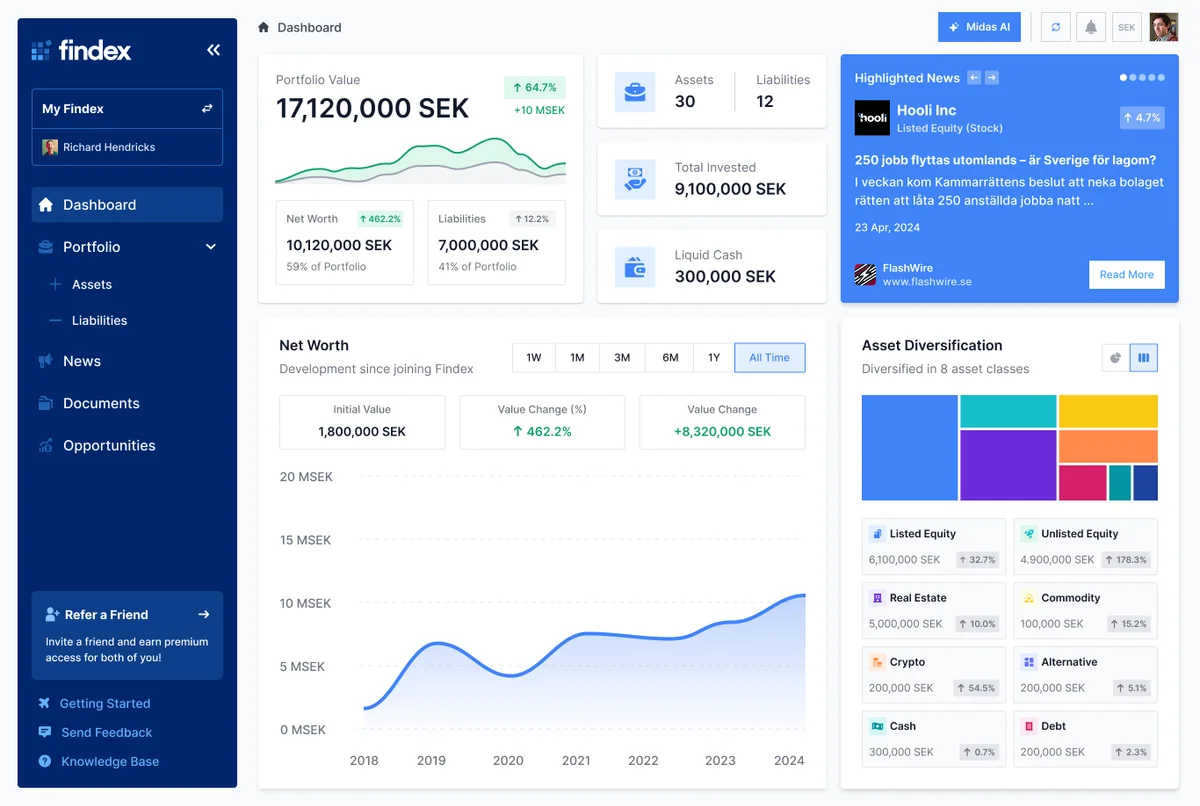

How Do Private Investments Fit Into a Modern Investment Portfolio? A Complete Integration Guide
Learn how to integrate private investments into a modern portfolio. Understand their role, structural risks, and how unified solutions like Findex enhance portfolio oversight and allocation management.

For much of recent history, private market investing has centered around issues of access: Could individual investors participate in private equity, venture capital, or private credit transactions that were once reserved for institutions?
This question has largely been addressed. Advances in technology and regulatory frameworks have expanded private market participation, enabling eligible individuals to engage directly through platforms, feeder funds, and new digital syndicates.
The more pivotal challenge has now shifted from access to integration:
How do private investments fit alongside public assets in a portfolio designed for effective long-term decision-making, disciplined liquidity management, and robust oversight?
Incorporating private assets as an “add-on” to a public portfolio reflects a fundamental misunderstanding of portfolio architecture. Successful integration requires clarity not only about the value of private assets, but also about the structural implications these assets introduce across the portfolio system.
The Role of Private Investments in Modern Portfolio Construction
Private assets serve distinct functions compared to public equities or fixed income. Their inclusion introduces new sources of both potential return and risk, as well as extended time horizons—demands that require rigorous portfolio integration.
1. Accessing Growth Beyond Public Markets
Public markets represent only a segment of global economic activity. Substantial innovation and business value typically accrue during periods when companies remain private.
Allocating capital to private equity or venture assets provides investors with direct exposure to value creation that is generally inaccessible in traditional public markets—capabilities that can capture the high-growth phases prior to IPO or acquisition.
2. Diversification and Risk Mitigation
Private investments generally demonstrate lower correlation with the volatility of daily public market movements. Though not insulated from broader macroeconomic patterns, their valuation processes and investment timelines provide a form of risk mitigation, helping to stabilize overall portfolio volatility through genuine diversification.
3. Commitment to Long-Term Horizons
Multi-year lockups in private markets impose a structural discipline on capital. Rather than facilitating short-term trading reactions, these strategies align capital with enduring business themes and multi-year growth cycles, reinforcing a disciplined, long-term compounding approach.
Key insight: Introducing private assets does more than diversify exposure—it transforms portfolio time structure by embedding long-term compounding and controlled liquidity.
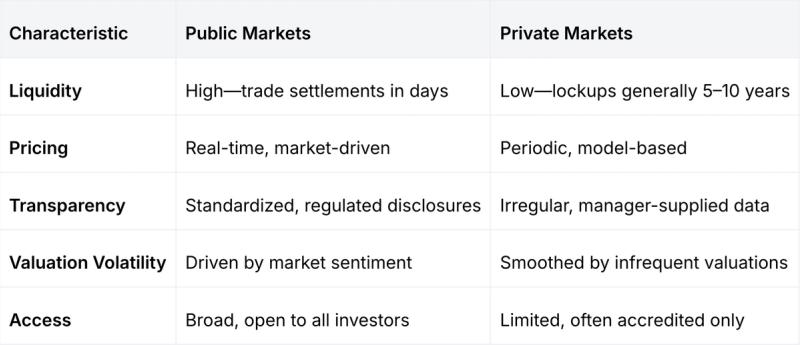
Public vs. Private Assets: Key Structural Differences
Constructing a truly integrated portfolio requires a precise understanding of how public and private assets fundamentally differ.
Why This Matters
- Liquidity mismatch can constrain cash flow and hinder rebalancing.
- Delayed pricing undermines timely portfolio assessment.
- Non-standard reporting increases the operational complexity of oversight.
A failure to recognize these distinctions risks poor asset allocation decisions, mistimed liquidity management, and undetected portfolio imbalances.
Strategic Allocation: How to Size and Structure Private Investments
Integrating private assets requires allocation decisions informed by more than a percentage target. It demands a rigorous approach to commitment pacing, liquidity budgeting, and rebalancing constraints.
1. Liquidity Planning
Capital committed to private funds is unavailable for redeployment until a liquidity event. Maintaining a defined liquidity budget—a calculated ratio between accessible public market assets and capital allocated to illiquids—supports operational flexibility, informed rebalancing, and contingency management.
2. Commitment and Call Management
Private market investments are deployed incrementally. An investor may commit $250,000 to a private fund, but drawdowns typically occur in tranches over time.
Without anticipating these capital calls, liquidity shortages can arise, potentially forcing sales of public assets under suboptimal market conditions.
3. Rebalancing Limitations
Unlike public positions, private investments are not readily reduced or reallocated. Thus, the liquid segment of the portfolio must be actively managed to adjust for valuation lags and ensure the overall allocation remains aligned with strategic objectives.
Key takeaway: Allocation to private assets must be considered across several dimensions—commitment size, deployment schedule, liquidity budget, and investment duration.
The Visibility Problem: Why Integration Matters
The introduction of private investments presents persistent challenges to portfolio visibility. Without appropriate infrastructure, investors risk losing clarity regarding performance, exposure, and risk.
1. Reporting Frequency
Public market portfolios can be monitored daily. By contrast, private assets are typically valued quarterly, often via disparate sources such as emailed reports or platform logins. This lag complicates timely and accurate portfolio assessment.
2. Comparability of Performance
Private investments are tracked using metrics like IRR and MOIC, which do not directly align with traditional public market returns. Without data normalization, evaluating the performance contribution of private holdings is imprecise.
3. Fragmented Oversight
Dispersed private asset data—spread across different custodians, administrators, and reporting formats—results in silos that impede comprehensive portfolio analysis.
Fragmentation makes it difficult to:
- Evaluate sector-level exposures spanning public and private assets
- Manage the “denominator effect” as public market valuations change
- Assess portfolio risk and allocation with analytical confidence
Visibility is foundational. Effective risk and performance management require unified, real-time oversight across all holdings.
Managing Public and Private Assets as a Cohesive System
A robust investment system integrates all assets into a single analytical context rather than treating public and private exposures as disconnected components.
1. Unified Oversight
Centralized platforms that aggregate data from public and private markets enable clear, comprehensive views of total exposure, liquidity, and risk—empowering more effective decision-making.
2. Consistency in Reporting and Analytics
Standardizing valuation frequency, performance measurement, and currency treatment creates a consistent data environment. This facilitates accurate analysis and informed comparisons.
3. Dynamic Allocation Monitoring
Automated systems can identify allocation drift in real-time, adjusting for delayed repricing in private assets and highlighting shifts that may warrant strategic rebalancing.
When Private Investments Become a Structural Challenge
While private markets can support diversification and return objectives, unmanaged exposures risk destabilizing portfolio oversight.
Structural risks emerge when:
- Allocation drift pushes illiquid exposures beyond target ranges
- Liquidity planning is insufficient, leading to forced liquidations
- Risk attribution relies on incomplete or outdated information
In such cases, private investments cease to add strategic value and become sources of operational risk.
Building the Infrastructure for a Multi-Asset Portfolio
A modern, multi-asset portfolio is inherently data-driven. Successful management depends on systems that provide complete, accurate oversight—spreadsheets and static tools are no longer adequate.
Findex: Enabling Unified Portfolio Management
Findex offers investors an integrated infrastructure to consolidate public and private assets with precision:
- Aggregate all holdings—across banking, brokerage, fund, and alternative investment platforms
- Normalize data for consistent, apples-to-apples comparisons of value and performance
- Visualize liquidity tiers, sectoral exposures, and risk factors
- Automate reporting, highlight the denominator effect, and enable disciplined monitoring
With Findex, private investments are fully integrated into the analytical framework—allowing for better oversight and more informed strategic decisions.
👉 Discover how Findex’s Unified Portfolio Platform brings clarity to complex portfolios.
Frequently Asked Questions (FAQs)
1. What percentage of a portfolio should be allocated to private investments?
Sophisticated portfolios often allocate 10–30% to private assets, adjusting for liquidity requirements, time horizon, and access to high-quality opportunities.
2. Are private investments riskier than public ones?
They introduce unique risks—especially regarding illiquidity and transparency—but offer the potential for superior long-term returns when managed rigorously.
3. How often are private investments valued?
Typically on a quarterly or annual basis. This reporting lag smooths out volatility, making active, normalized tracking essential.
4. Can I rebalance a portfolio that includes private assets?
Direct rebalancing is not possible; adjustments are made via liquid holdings, using public market exposure to maintain the desired overall allocation.
5. What is the “denominator effect”?
When public market values fall, the relative weight of illiquid private assets rises because their valuations update less frequently, potentially distorting the intended allocation.
6. How can I track private and public assets together?
Specialized platforms like Findex aggregate and normalize all assets in real-time, providing the comprehensive visibility required for robust portfolio management.
Keep reading
Related guides

How Should I Structure a Modern Investment Portfolio? A Guide to Building a Future-Proof Investment Framework
Move beyond the outdated 60/40 model. Learn how to structure a modern investment portfolio using systems thinking, liquidity tiers, and functional asset allocation for optimal performance.

How to Measure Your Portfolio’s True Performance
Learn to measure your portfolio's performance with time-weighted and money-weighted returns, risk-adjusted metrics, and benchmarking strategies.

How to Build a Balanced Portfolio With Both Index Funds and Stocks
Learn how to build a balanced investment portfolio with index funds and stocks. Explore strategies, avoid pitfalls, and optimize returns with ease.
Your complete net worth, finally in one place.
Join investors using Findex to consolidate, track, and grow their portfolios. One view of everything you own.
No payment information required.