
How Should I Structure a Modern Investment Portfolio? A Guide to Building a Future-Proof Investment Framework
Move beyond the outdated 60/40 model. Learn how to structure a modern investment portfolio using systems thinking, liquidity tiers, and functional asset allocation for optimal performance.

Contemporary portfolio construction has evolved considerably, yet the conceptual frameworks many investors use remain rooted in an earlier era. The realities of private markets, digital asset classes, and a broad array of alternative investments have redefined not only what can be owned but also how investments should be structured, analyzed, and monitored.
Despite this transformation, prevailing portfolio models are often anchored in mid-20th-century paradigms—frameworks built around public equities and government bonds, and ill-equipped to evaluate liquidity constraints, interconnected exposures, and the complexities arising from fragmented holdings. The result is a persistent gap between what is possible and how portfolios are actually managed. To achieve robust outcomes in this environment, investors require a systematic approach that emphasizes integration, liquidity management, and real risk analytics, moving decisively beyond static asset inventories.
From Asset Lists to Portfolio Systems
For much of the last century, investor portfolios were managed as static lists—essentially registries of securities aggregated within a single brokerage account or custodian. Today, investment holdings are distributed across multiple institutions, platforms, and asset types: digital wallets, private capital vehicles, global funds, and direct investments in alternatives.
This multi-platform landscape exposes investors to material visibility and control challenges. The attempt to manage diversified but disconnected asset lists frequently creates unrecognized concentrations, inefficiencies, and blind spots.
A modern portfolio structure is defined as a system, not a sum of parts. In systemic portfolio design, the interplay of assets—how exposures aggregate or offset under varying economic and market regimes—becomes the fundamental focus. For example, technology ETFs and venture funds may be housed separately but share core dependencies on liquidity cycles and macroeconomic drivers. Robust structuring demands an integrated approach that clarifies these relationships and provides context for informed capital allocation.
Core Building Blocks of a Modern Portfolio
Resilient portfolios are engineered across three foundational dimensions:
- Allocation by functional role
- Liquidity profile and segmentation
- Risk exposure mapping
1. Allocation: Function Over Label
Legacy asset allocation strategies segment investments by superficial categories (e.g., large-cap equities). Modern frameworks demand allocation by economic function—deliberately assigning capital to roles within the system.
Functional Allocation
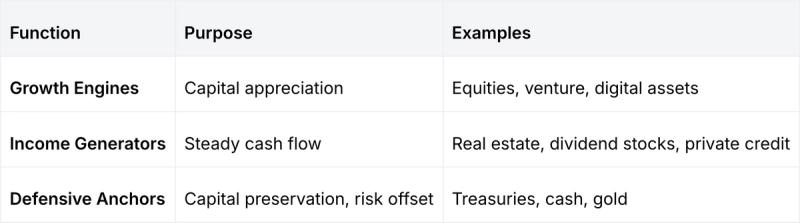
Function-based design provides control over portfolio dynamics, reducing duplication and ensuring exposures align with investor objectives rather than legacy labels.
2. Liquidity: New Constraints
While traditional portfolios assumed ready liquidity, the inclusion of private investments fundamentally alters access to capital. Explicit liquidity segmentation is now essential.
Liquidity Tiers
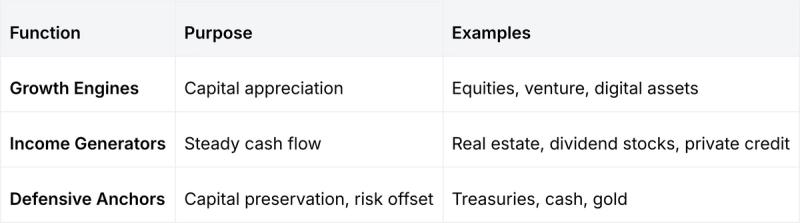
A disciplined liquidity framework maintains sufficient reserves to address cash needs and portfolio rebalancing—minimizing the risk of forced asset sales under adverse conditions.
Insight: A dedicated liquidity buffer is critical for covering commitments and capitalizing on market dislocations.
3. Risk Exposure: Beyond Simple Volatility
Single-metric risk assessments (e.g., volatility) are inadequate. Holistic risk management requires deconstructing exposures by macroeconomic drivers:
- Interest Rate Sensitivity: Quantifies vulnerability to policy changes.
- Currency Exposure: Identifies concentration across major denominations.
- Sector/Systemic Risks: Highlights true thematic exposures that may otherwise be disguised by asset categorization.
Comprehensive risk analytics synthesize exposures held across all accounts and asset classes, enabling management to preempt destabilizing events.
Public vs. Private Assets: Implications for Structure
Introducing private assets into the portfolio is now standard but poses unique structural and analytical challenges.
- Public assets: Offer transparency via daily valuation but exhibit higher mark-to-market volatility.
- Private assets: Are valued infrequently, resulting in return smoothing and opacity regarding real risk.
This division gives rise to the "denominator effect," distorting perceived allocation when public asset values fall and private holdings—absent reactive marking—appear to gain relative weight. For accurate oversight, portfolios require methods that account for both real liquidity constraints and cross-asset drivers.
Managing Public and Private Exposures
- Treat private holdings as long-duration components, not tactical allocations.
- Preserve rebalancing latitude with adequate liquidity reserves.
- Assess exposures on a look-through basis—focus on underlying sector, credit, or geographic risks rather than surface-level asset class buckets.
Without coordinated oversight, private asset integration can undermine both liquidity management and risk accuracy.
Why Visibility Matters More Than Complexity
Portfolio effectiveness hinges on the clarity and timeliness of information, not complexity. An intricate portfolio constructed with limited visibility and fragmented reporting delivers less effective risk management than a transparent, fully aggregated system.
The Case for Visibility
- Enables real-time, accurate decision-making by consolidating disparate data.
- Surfaces hidden concentrations and correlated exposures before they escalate.
- Supports disciplined management through automated monitoring and data-driven rebalancing.
Ultimately, better outcomes depend on robust data infrastructure—where investors gain actionable perspectives on their actual exposures and positionings. Complexity that outpaces visibility compounds, rather than mitigates, risk.
Transitioning to a Modern Portfolio Architecture
The evolution of portfolio management is not about discarding foundational principles but about adapting them for a diverse, interconnected platform landscape. Key priorities include:
- Functional allocation tied to system roles.
- Rigorous liquidity segmentation.
- Quantifiable, actionable risk mapping.
- Unified, real-time visibility across all holdings.
Integrating these principles transforms the portfolio into a flexible, self-correcting system that supports both responsive action and long-term discipline—a necessity in today’s unpredictable markets.
Optimize Modern Portfolio Structure with Findex
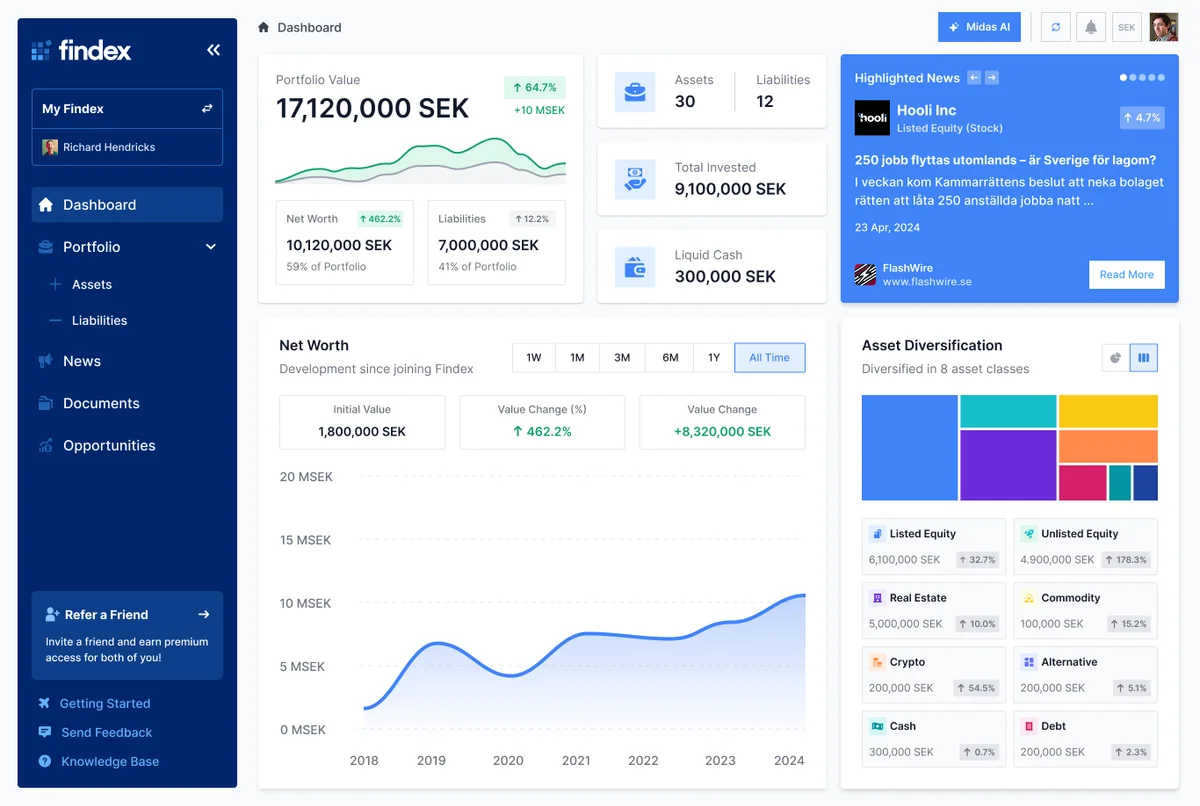
Effective management of portfolio systems at scale demands automation and operational rigor. Findex addresses these challenges by centralizing public, private, and digital asset data into an integrated, real-time dashboard.
With institutional-grade infrastructure, Findex delivers:
- Comprehensive asset allocation analysis
- Liquidity management at all tiers
- Aggregated risk diagnostics
By providing actionable visibility, Findex equips investors to make well-informed decisions, manage exposures proactively, and align portfolio structure with long-term objectives.
Explore Findex today to bring discipline and insight to all your investment strategies.
Frequently Asked Questions (FAQs)
1. What defines a modern investment portfolio?
A modern portfolio combines public, private, and alternative assets in a unified system, structured for liquidity management, functional purpose, and data-driven risk visibility.
2. How is a modern portfolio different from the traditional 60/40 model?
Traditionally, portfolios emphasized stocks and bonds, assuming high liquidity and low correlation. The modern approach incorporates illiquid assets, global diversification, and emphasizes system-level risks rather than static allocations.
3. What’s the ideal liquidity mix in a portfolio?
Liquidity needs are individualized, but a common benchmark is maintaining 20–30% in liquid assets to ensure flexibility and support strategic rebalancing.
4. How can I manage private assets effectively?
Digital platforms like Findex integrate private holdings with public market data, enabling real-time tracking of allocations and exposures within a single reporting framework.
5. Is diversification still relevant in modern portfolios?
Absolutely—but the focus has shifted to functional diversification (i.e., growth, income, defense), which addresses correlated risks more effectively than traditional asset class diversification.
6. What’s the biggest mistake investors make today?
Conflating complexity with sophistication. In reality, clarity, transparency, and unified visibility—underpinned by robust data—are the defining traits of successful portfolios.
Keep reading
Related guides

How Do Private Investments Fit Into a Modern Investment Portfolio? A Complete Integration Guide
Learn how to integrate private investments into a modern portfolio. Understand their role, structural risks, and how unified solutions like Findex enhance portfolio oversight and allocation management.

How to Measure Your Portfolio’s True Performance
Learn to measure your portfolio's performance with time-weighted and money-weighted returns, risk-adjusted metrics, and benchmarking strategies.

How to Build a Balanced Portfolio With Both Index Funds and Stocks
Learn how to build a balanced investment portfolio with index funds and stocks. Explore strategies, avoid pitfalls, and optimize returns with ease.
Your complete net worth, finally in one place.
Join investors using Findex to consolidate, track, and grow their portfolios. One view of everything you own.
No payment information required.