

What Information Do Investors Actually Expect? A Founder’s Guide to Investor Reporting and Transparency
Investors demand transparency, not pitch decks. Learn what information investors actually expect—from capital efficiency to risk management—and how clear reporting builds lasting trust.

Investor expectations are rarely explicit, yet many founders operate on assumptions. Within capital management and governance, this gap between perceived and actual investor needs frequently leads to miscommunication. It is not uncommon for founders to overestimate the importance of narrative polish, while overlooking the factual rigor and structured reporting that professional investors require for decision-making.
Contrary to belief, experienced investors—across angel, venture, and institutional profiles—prioritize consistent, data-driven transparency. The absence of orderly, accurate reporting is not a trivial gap; it introduces uncertainty and undermines trust. Addressing this calls for a transition: founders must move from intuitive “pitching” to systematic “reporting.” This shift demands disciplined processes, a sharp focus on key business drivers, and communication unburdened by unnecessary embellishment.
Core Information Investors Care About in Startup Reporting
Investors systematically scrutinize company progress through several core lenses: current performance, underlying risks, and clarity about future direction. Evaluation does not hinge only on outcomes, but also on the mechanisms behind them and their implications for valuation and liquidity.
1. Performance Metrics That Truly Matter to Investors
Surface metrics and vanity figures—such as aggregate sign-ups or raw traffic—are deprioritized. Instead, investors require quantitative evidence of business viability through key economic drivers.
- Capital Efficiency: Measures like Burn Multiple and CAC Payback Period provide a direct view of how resource allocation translates into sustainable revenue.
- Retention and Churn: Net Revenue Retention (NRR) and logo churn quantify depth of product-market fit and customer loyalty.
- Liquidity and Runway: Cash runway assessments, including scenario-based zero-cash-date calculations, are central. Precision here enables investors to anticipate capital needs and set expectations for future funding cycles.
Proactive Risk Reporting: What Smart Investors Expect
A credible founder does not omit discussion of risk; they analyze, disclose, and address it with specificity. Professional investors interpret the absence of risk disclosure as either lack of insight or unwarranted optimism. Structured identification of risks—regulatory, competitive, or channel-related—combined with a concrete mitigation strategy, is seen as sound governance.
Strategic Direction and Capital Allocation Transparency
Rigorous reporting links historical data with forward-looking strategic intent. Investors assess not only how capital has been managed but also the rationale and anticipated outcomes for its future deployment.
- Are investments being redirected from R&D toward sales efficiency?
- Is the go-to-market strategy evolving to align with market feedback?
Effective reports clearly map financial allocation to business priorities, reinforcing a transparent narrative for future growth and resource application.
What Founders Often Overemphasize in Investor Updates
Effort in investor communication is often misdirected. Recognizing which elements carry less weight helps founders focus on substantive value.
1. Over-Designed Investor Updates
Aesthetics are secondary. Investors value structured, accessible data over visual presentation. Concise tables and direct bullet points support analytical review far more than extensive design.
2. Minor Product Updates
Unless a product feature fundamentally changes commercial outcomes, the technical details are unlikely to matter. The focus remains on operational and financial impact, not incremental product iterations.
3. Short-Term Variance Panic
Isolated fluctuations are rarely material to investment theses. Sophisticated investors assess rolling twelve-month trends and expect leadership to contextualize, not overexplain, the noise within short-term numbers.
How Investor Expectations Evolve Through Funding Stages
Information requirements shift as organizations scale. Establishing which metrics are relevant at each phase enables effective alignment.
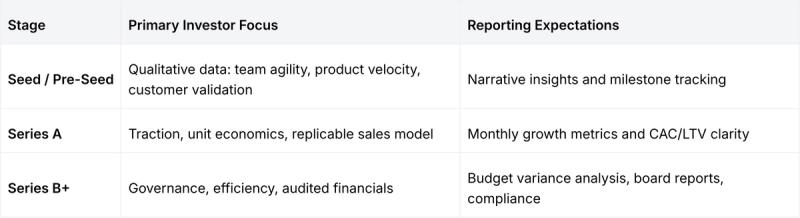
Neglecting to elevate reporting with company maturity is often perceived as inexperience.
Why Financial Clarity Builds Long-Term Investor Trust
Trust is anchored in the consistency, completeness, and timeliness of data. Prompt disclosure of challenges, supported by clear evidence and remediation pathways, builds credibility and reduces oversight costs for investors.
Transparent information flows also enhance investor engagement. When the operational picture is accessible and interpretable, investors are positioned to offer informed support. High clarity transforms passive capital partners into strategic resources.
Meeting Investor Expectations: From Confusion to Consistency
Breakdowns in investor relations stem less from malintent than from confusing, inconsistent information. Without a robust system, founders struggle to centralize and communicate essential data—while investors miss context and actionable insight.
Prioritizing the essentials:
- Capital efficiency
- Accurate risk reporting
- Strategic clarity
is the foundation for trust and effective collaboration.
Automate Investor Reporting for Clarity and Credibility
Actionable investor reporting demands infrastructure that reduces friction and standardizes outputs. Findex Investor Relations is designed to streamline data consolidation and present insights in formats aligned with professional expectations—delivering clarity and consistency without the burden of manual compilation.
👉 Avoid the pitfalls of inadequate reporting. Explore Findex Investor Relations and ensure your investor communications become a catalyst for strategic alignment and growth.
Frequently Asked Questions (FAQs)
1. What financial data do investors care about most?
Investors prioritize cash flow, runway, burn rate, CAC, and retention metrics. These indicate efficiency and sustainability.
2. How often should founders update investors?
Monthly for early-stage startups, quarterly for later-stage companies—consistency is more important than frequency.
3. Do investors prefer narrative or data?
Both. Narratives without data lack credibility; data without narrative lacks context.
4. Should founders share bad news with investors?
Yes. Prompt, data-backed transparency strengthens trust and confidence.
5. How do investor expectations change by funding round?
Seed investors look for validation, Series A for traction, and Series B+ for governance rigor and predictability.
6. What’s the biggest mistake founders make in investor communication?
Over-spinning or withholding information. Sophisticated investors always detect inconsistencies.
Keep reading
Related guides
How to Send Investor Updates: A Startup Guide

How Often Should Companies Update Investors? A Strategic Guide to Reporting Cadence and Investor Communication
Discover how often companies should update investors and why consistency beats frequency. Learn how company stage, ownership structure, and operations determine the right reporting rhythm.

How to Write a Clear Investor Update (With Real Examples)
This guide details the key elements of high-quality investor updates, offering examples and templates to help founders build trust and streamline reporting.
See Findex for companies in action
Book a personalised walkthrough — we'll show you how Findex streamlines cap table, shareholder communication, and investor reporting.
- White-glove onboarding for your team
- Branded investor portal in under 48 hours
- No setup fees — pay only when you scale