

How Often Should Companies Update Investors? A Strategic Guide to Reporting Cadence and Investor Communication
Discover how often companies should update investors and why consistency beats frequency. Learn how company stage, ownership structure, and operations determine the right reporting rhythm.

There is a persistent misconception within the startup community that an increase in communication frequency translates to greater transparency or operational excellence. Many founders believe that inundating investors with weekly updates or a stream of informal messages constitutes effective reporting. This approach is not only inefficient, but it can also obscure critical business signals and undermine credibility.
Effective investor communication is defined by precision and structure, not volume. Over-communication can mask underlying trends, dilute the impact of material updates, and inadvertently suggest a lack of operational focus. Investors do not allocate capital to increase their information load—they are seeking assurance in data-driven decision-making and evidence of governance discipline.
The fundamental question is not how often to communicate, but rather how to establish a reliable, standardized reporting cadence that delivers clarity and supports sound oversight.
Understanding What Investors Actually Expect in Company Updates
Expectations regarding investor updates are relatively standardized across the capital markets. While there are nuanced variations, most stakeholders anticipate communication patterns that reflect business velocity and the prevailing stage of a company’s lifecycle.
- Early-stage startups (Pre-Seed to Series A): Investors expect monthly updates. This cadence aligns with rapid operational change, helping stakeholders monitor inflection points in product development, talent acquisition, and capital deployment.
- Growth-stage companies (Series B and beyond): Quarterly updates are typical. At this point, the enterprise operates on longer feedback cycles, making periodic performance reviews more informative and less prone to noise.
Key Information Every Investor Update Should Include
Regardless of frequency, robust reporting should adhere to a consistent and data-centric structure. Investors prioritize the following:
- Quantitative Health: Real-time assessment of cash position, monthly burn, and capital runway.
- Commercial Progress: Clear tracking of revenue trajectories, new bookings, and metrics that evidence market traction.
- Strategic Context: Highlights of recent accomplishments, encountered obstacles, and explicit requests for support or guidance—especially those that leverage investor networks.
Factors That Determine the Ideal Investor Update Frequency
“Monthly” may be conventional, yet effective reporting is context-specific. The ideal cadence depends on a company’s developmental stage, the composition of its ownership, and the operational activity it is experiencing.
1. Company Stage: From Pre-Seed to Series B and Beyond
- Pre-Seed / Seed Stage: High volatility and limited financial margin require monthly reporting. This ensures timely reflection on strategic pivots and capital sufficiency.
- Series A – Series B: As organizations stabilize, maintaining either monthly or bi-monthly updates can demonstrate continued progress while reducing administrative burden.
- Growth Stage (Series B+): Quarterly communication is generally adequate, capturing meaningful developments in operational performance and resource allocation.
2. Ownership Base: Who’s on Your Cap Table Matters
The reporting cadence must also align with the requirements and expectations of the investor base:
- Institutional Venture Capital (VC) Firms: These partners adhere to internal governance and regulatory standards. They require uniform and punctual updates, typically monthly or quarterly, to inform their own upstream reporting.
- Angels and Family Investors: Less rigid, often valuing concise narratives or qualitative insights delivered at a frequency appropriate to their engagement level. Short updates or well-structured summaries remain best practice.
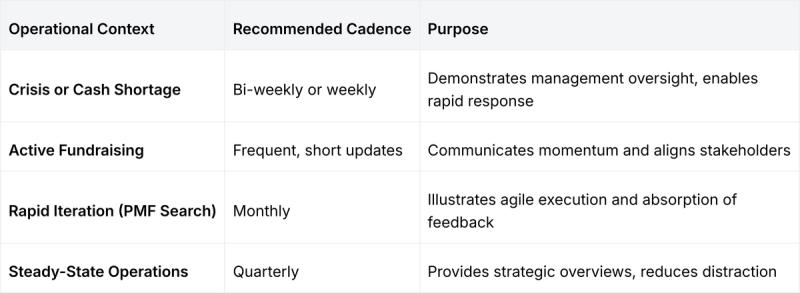
3. Operational Activity: Let Reality Dictate Cadence
Extraordinary circumstances necessitate adaptive reporting schedules:
Common Mistakes Founders Make in Investor Communication
Most communication failures result not from intent, but from process. The following missteps can erode investor confidence and diminish the quality of oversight:
1. The “Good News Only” Trap
Selective reporting distorts risk perception and delays intervention. Professional investors expect transparency, including setbacks and lessons learned.
2. Irregular or Inconsistent Cadence
Reporting gaps create ambiguity. Unscheduled or missed updates can be construed as signs of leadership or control issues.
3. The “Data Dump” Problem
Providing unprocessed data without actionable synthesis contradicts the purpose of reporting. Investors expect management to contextualize and interpret performance trends.
4. Total Silence (Ghosting)
The absence of updates escalates concern, leading investors to suspect severe operational or financial distress. Prolonged silence is the single most damaging communication failure.
Why Consistency Beats Frequency in Investor Updates
The ultimate value of investor reporting lies in its ability to construct a transparent, longitudinal record of business performance.
Sophisticated investors are seeking to identify directional trends, not isolated data points. Introducing variable metrics or changing reported KPIs disrupts comparability over time and weakens the utility of updates.
Predictability Builds Governance Capital
A systematic, timely cadence yields several advantages:
- Diminishes unnecessary ad-hoc information requests.
- Reduces insecurity and reactivity among stakeholders.
- Demonstrates disciplined management and strengthens institutional trust.
Consistent, predictable updates establish a far stronger signal of operational competence than sporadic or excessive outreach.
How to Automate Investor Reporting Without Losing the Human Touch
Manual efforts in investor communications often lead to errors, delayed reporting, and inconsistent standards. This undermines the goal of building trust through effective disclosure.
Professionalizing Your Reporting Cadence with Findex Investor Relations
Findex Investor Relations is engineered to resolve these inefficiencies. By aggregating financial data from multiple sources and generating standardized reports, the platform ensures investors access timely, comprehensive, and actionable information.
Automated systems provide institutional-grade transparency without sacrificing the critical context or nuance that effective communication requires.
👉 Explore Findex Investor Relations to elevate your reporting process and deliver the standard of governance investors expect.
Frequently Asked Questions (FAQs)
1. How often should early-stage startups update investors?
Monthly updates are recommended to reflect dynamic progress and maintain accountability.
2. When should established companies switch to quarterly reporting?
Transition after Series B, once operational momentum is established and longer-term metrics are more relevant.
3. What happens if a company skips an update?
Lapses in reporting generate uncertainty and prompt concerns about organizational stability.
4. Should founders include bad news in updates?
Yes. Clear, timely disclosure of setbacks fosters trust and enables aligned support.
5. What’s more important—frequency or consistency?
Consistency. Reliable reporting cadence is more valuable than high frequency without structure.
6. Can investor updates be automated?
Absolutely. Solutions such as Findex Investor Relations streamline reporting and improve accuracy, allowing management teams to prioritize value creation.
Keep reading
Related guides
How to Send Investor Updates: A Startup Guide

What Information Do Investors Actually Expect? A Founder’s Guide to Investor Reporting and Transparency
Investors demand transparency, not pitch decks. Learn what information investors actually expect—from capital efficiency to risk management—and how clear reporting builds lasting trust.

How to Write a Clear Investor Update (With Real Examples)
This guide details the key elements of high-quality investor updates, offering examples and templates to help founders build trust and streamline reporting.
See Findex for companies in action
Book a personalised walkthrough — we'll show you how Findex streamlines cap table, shareholder communication, and investor reporting.
- White-glove onboarding for your team
- Branded investor portal in under 48 hours
- No setup fees — pay only when you scale